Skip to content

Posts tagged ‘don pedro garcia cruz’

A day with Don Pedro Garcia

I’ve written before about Don Pedro Garcia, a palenquero based in San Dionisio Ocotepec, and over the past year it has become an incredible experience to develop a friendship with him. So of course heading to San Dionisio was top priority as soon as I got to Oaxaca.

It was an early Saturday morning when we piled into the car to go see him – three Oaxaqueñas and myself.

It was December 1st, the same day Enrique Peña Nieto (EPN) assumed the presidency here in Mexico. There were rumors of potential roadblocks, hence our early departure to try and avoid any problems. We stopped first at the market in Tlocolula to pick up supplies for the comida were going to cook him in honor of his birthday – tasajo, chorizo, chiles, cecina, tlayudas, cebollitos, aquacates, the usual fair for a simple meal. We had of course assumed there would be a grill.

The conversation in the car was filled with politics and news of what was happening in Mexico City. The road was particularly quiet and, despite the occasional pinche topes, in far better shape than it had been last April. The sky was unusually cloudy, and there was a crispness in the air and the smell of wet that made me think it might rain despite it being the dry season.

Our makeshift grill

Don Pedro was sitting quietly in his palenque when we arrived, watching the TV coverage of EPN’s speech. The still was fired, the table cleared and cleaned, 4 glasses set (Don Pedro rarely drinks) and chairs arranged. There was no grill so we began concocting a makeshift area by the still – piling hot coals so we could start roasting the chiles. We did eventually find a pan and a rack to place the meat and cebollitos on. Conversation ranged from catching up on the news to the rising costs of maguey and, of course, love. Don Pedro loves to tell stories of love found and then lost. He happily held court – I can’t imagine the last time he entertained four women in his Palenque.

Roasting chiles in the coals.

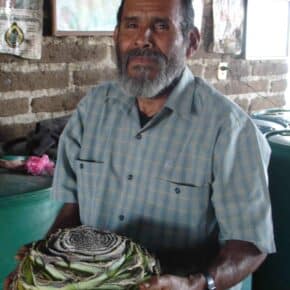
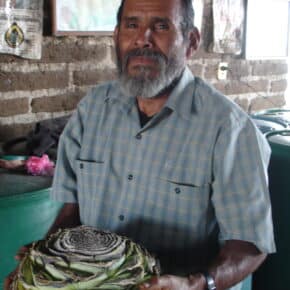
Ana, Mariana, Marisol and I each put ourselves to tasks – cleaning the roasted chiles, cutting aguacates and limon, turning the meat until finally it was all done and we sat down together to eat and drink and share more stories. We toasted his birthday, though we still have no idea what his actual age is – 60, 65, 70. His eyes are deeply set, and a sharp chocolate brown. His beard is more gray than black. On this particular day, it was more neatly groomed than I had previously seen – but then again, he was entertaining.

He chastised me briefly for not calling more often. I spoke of my sister’s death, my looming guardianship of my 8 year-old nephew. He spoke of life and death, and mentioned once more, that once he dies, so does his mezcal. He has no children and no one to take over the operation once he is gone.

Susan cooking on the still

Raindrops fell briefly on the aluminum roof, the air cooled more, and we sat in silence for several minutes, letting the meal settle, the mezcal make its way down our throats.

What does mezcal mean to Don Pedro? We listened as he began talking again, reflecting on the sadness of life sometimes, and the bad times. And how he saw his mezcal as a cure for that – a way to take away those things and bring some joy back. Medicine for the soul.

I am excited to have his mezcal at a quickly arranged tasting here in Oaxaca, to have him on the terrace at Café Central where he can share his stories with more people, and they can come to love and appreciate him, and his mezcal, as much as I have.

Fresh mezcal

Pop-up Mezcaleria in Oaxaca

It’s a crazy idea, to host a Pop-up Mezcaleria in Oaxaca, but we love crazy and we love challenges. Mezcalistas will be hosting its first ever Pop-up Mezcaleria in Oaxaca, Friday, December 14th on the Terrace at Cafe Central. We’ll be tasting two mezcals, a minero and a pechuga, from Don Pedro of San Dionisio Ocotepec. He’s been making mezcal for the past 40 years out of his one still palenque. It’s a great opportunity to share his delicious mezcal with the public as he has only been selling his product to private clients and to a small shop in Ocotlan. There will also be bottles and Tlayudas and Garnachas from El Teatro Culinario for sale. Details are as follows:

Pop-up Mezcaleria
Friday, December 14th, 2012
La Terraza at Cafe Central, Hidalgo 301, centro
9pm-11pm
50 pesos for two mezcals
120 pesos for a bottle of minero
250 pesos for a bottle of pechuga

Meeting Palenqueros

So what is it with me and mezcal and this crazy obsession? I love the flavor, I love the story, I love that it is rough and wild and makes me think of my Appalachian roots and the assumed moonshiners in my family tree. And so why not go straight to the source: Why not find those OP’s (original palenqueros)? Why not get out into the countryside and the mountains to see what it’s all about?

There is no “mezcal trail” so to speak, but there are several pueblos known for their mezcal. In Matatlan,  the main road divides the town, and each side is lined with touristy mezcal rooms. But erase any thoughts of Napa’s Silverado Trail. And so that first trip, 4 of us (and a baby) piled into a tiny Chevy Aveo – rental mistake on my part – and headed out to San Dionisio and then Chichicapam – a beautiful valley area about 1.5 hours outside of Oaxaca. San Dionisio begs the question – what came first, the town name and then the mezcal or vice versa?

Don Pedro and Susan sharing a mezcal moment

And Dionysus was definitely smiling down on us as we walked into a Palenque, operated by Don Pedro Garcia Cruz, walls filled with pictures of half and fully naked women. Mezcal is a man’s world, not the drink, but the world.  So, being a woman, and a foreign one at that, walking into one of these places certainly creates a stir, especially when you aren’t accompanied by a husband. It can cause a certain palenquero to declare “Estoy aca solo” (I am here alone) and to propose marriage. It can mean accepting a hand on the small of your back as you discuss production capacity, where the maguey comes from, how it is blended, and then tasting the sweet strong nectar. It can mean the back-story of what that bottle of mezcal might eventually be named. Don Pedro produces a divine espadin. The first taste is a fiery jolt on the front of your mouth before it then warmly slides down the back of your throat. You are intrigued and take a second sip, this time the complex flavor – slightly roasted, slightly sweet – surrounds the back of your mouth. By the third sip you are declaring it perfect and seriously considering the marriage proposal…

Master Palenquero Alfonso Sanchez

And then it was off Chichicapam, the next valley over, and to another Palenque:  more blends, more tasting, and the opportunity to learn how blends are done and how the perlas (bubbles) tell you how much alcohol is in that blend. Making perlas is no easy feat. It requires using a 2 foot long piece of hollowed out wood called Carrizo – similar to a bamboo reed – to carefully suck up the mezcal from the jicara (gourd traditionally used for tasting) and then letting it stream back into the jicara. After several tries I was still not able to get the hang of it.

At this Palenque, Ñisa Tai, Alfonso Sanchez and his brother Jesus had us tasting their blends of the common espadin, the sweet mexicano, a delicious tobala (wild maguey) and a tobaziche – another wild maguey (for a great video of the process and the Palenque, check here.) The variation of flavors between the mezcals was amazing, and I must confess that Tobala is probably my favorite of the varieties. We also tasted a pechuga – a mezcal that is distilled with chicken or turkey breasts and bones – that knocked my socks off.

A side note about Alfonso, the palenquero for Ñisa Tai: His family has been producing mezcal for eons, and they are in fact the producers for one of the most prestigious, and expensive, artisanal brands sold in Mexico and in the United States. They are master producers, with an understanding of artisanal food and beverage production that is mind blowing. The reality is, the palenqueros rarely have their marca or brand on their bottles of mezcal, and are rarely acknowledged as the actual masters of the mezcal. I’ll address the economics of this system in a future post because it’s one of the most prominent issues deteriming the volume, price and quality of mezcal found in the market.

Then, more bottles were purchased, and an invitation was made to return the following week to join a maguey cut to see exactly how a harvest is done and the land it is grown on.  After, we dined on fried fish – mojarras – at a comedor and then made our way home.

Herb-infused mezcals made by palenquero Wilfreido Garcia Martinez of the Palenque Roaguia.

Two days later it was off to Hierve el Agua to taste more mezcal with palenquero Wilfreido Garcia Martinez of the Palenque Roaguia. This time, a larger car, though god-help us it was a brand new white jetta that was about to go on the ride of its life, up a winding rutted out road. Friends Max and Davina accompanied José Luis Diaz and I on this journey. It is a beautiful drive, and the town is famous for its sulfuric pools of water and the original (and natural) infinity pools that hug the side of a mountain. Here we tasted various herb infused mezcals and noted the flavor difference of the espadin.

Terroir is a huge element in the flavor profile and the magueys change in flavor, much like grapes, depending on the soil and the altitude.  Flavors can run from earthy and green, to slightly sharp or sweet. Rain patterns also influence the flavor, as does the ground water. Distilling and blending the mezcal is what distinguishes the novices from the masters. Each Palenque is therefore able to produce a unique mezcal, and because of that, an endless variety of flavors and experiences.

And after some memelitas, tlayudas and tacos, it was back on the windy road to return to Oaxaca, the sun setting majestically over the mountains and valley, the sound of rattling bottles in the trunk keeping beat with the music on the radio.