Skip to content

Posts from the ‘Making Mezcal’ Category

Journey to the Sierra Norte and Mezcal Tosba

One of the best things about going to palenques in Oaxaca is it usually means traveling to some of the most beautiful parts of the state. It also means traveling on some pretty rough roads, but more on that later.

I first met Elisandro Gonzalez-Molina in San Francisco at a mezcal tasting. He is one of the forces behind Mezcal Tosba, the other is his cousin Edgar Gonzalez-Ramirez. They are from the small pueblo of San Cristóbal Lachirioag in the Sierra Norte, a gorgeous and mountainous region northeast of the city of Oaxaca, and also one of the poorer regions in the state. Primarily Zapotec, with Mixtec pueblos mixed within, it is primarily alpine dotted by of tropical microclimates, not unlike what is found on the western side of the coastal mountains of Oaxaca.

Elisandro and Edgar came to the United States, like many of their pueblo neighbors, in order make a better life for themselves and also to send precious dollars back to San Cristóbal Lachirioag, a lasting legacy of NAFTA, that decimated these small agrarian pueblos in many parts of Oaxaca (and of course all over Mexico.) While in the US, they spent time talking about what they could do to bring economic opportunity to their pueblo, and staunch the flow of young people north. The idea of Mezcal Tosba was born; magueys were planted on Edgar’s family milpa beginning in 1999. In 2006 Edgar returned to Oaxaca to learn how to make mezcal.

The Sierra Norte is not a region currently known for mezcal production. Palenques had existed, but with so many people leaving the land for better opportunities, many of them were abandoned and the tradition began dying out. Far more common in the region was aguariente (a distilled beverage made from sugar cane), coffee and pulque.

Visiting Tosba soon became a obsession for me – not only for the opportunity to meet Edgar and see the Palenque, but also to have an excuse to travel to the Sierra Norte, where I had never been. Arranging it was another story – back and forth with Elisandro, coordinating with Edgar during one of his weekly trips to Oaxaca (there is no cell phone service in most of the Sierra Norte) and finally a meeting at In Situ to coordinate the details, including a map of how to get there.

There would be four of us on the journey – me, my partner in mezcal crime Ana JB and In Situ owners Ulises Torrentera and Sandra Ortiz Brena. We rented a more or less sturdy car (why car rental agencies in Oaxaca insist on using white cars is beyond me) and left the city at the crack of dawn on a Sunday morning.

I took the first leg of driving, mostly to ensure I’d be driving the “best” roads. Our plan was to hit the market in Ayutla, a Mixtec pueblo high in the mountains. We found a bustling commercial center where colectivo trucks unloaded people and their goods, and crisp in the clear, and quite cold, air. Luckily there was delicious coffee to be had and a filling breakfast of chilaquiles, enfrijolades and the best damn tortillas I have ever had (their rich corny flavor haunts my dreams to this day – think of the tortilla equivalent of the bread from Tartine.) We walked the market, taking in the sights and sounds of Mixteca and Zapoteca being spoken. We bought green coffee beans, flor del maguey, chilies and carne; the last to cook later that day at the Palenque. And then we found the pulque and tasted the seemingly infinite varieties and flavors to be found. Side note – I would travel for pulque and could become as obsessed with it as I am with mezcal.

We piled back in the car, though not before a couple of palenqueros called out to Ulises – we were after all traveling with a mezcal rock star – who were anxious to have him try their mezcals. It was not quite 9:30am.

I let Sandra take over the driving, a good thing because from Ayutla on it was dirt road – washed out, rutted, impassable during the rainy season, cliff hugging, you name it. The views were stunning and a constant reminder of just how high we were and just how far a drop it was off the edge of the road. I will never ever ever again complain about the pinche suburban trip to and from the coast in Oaxaca.

We met Edgar in the center of San Cristóbal, and from there, drove to the palenque – another 25 minutes on a rutted road, down the mountain. We parked our car at the top of the entry to the palenque because, while our car would have made it down, it never would have made it back up – it seems only Nissan Sentras can make that trip.

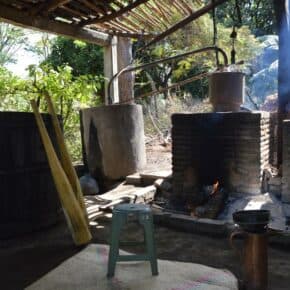
The palenque is nestled in one of the tropical microclimates. It is completely self-sustaining, growing everything needed for mezcal production – maguey, wood, fruits and vegetables – you name it, it grows. Currently there is one roasting pit, with plans for another. There is a large adobe building that will eventually house the bottling and labeling facility. Currently mezcal is transported to Oaxaca where it is bottled. There is a large tin roof covering the crushing area, the three fermentation barrels and three stills. There is no electricity, though Edgar is making plans for either solar or river generated power.

We ate papayas and lemons as Edgar showed us the lay of the land. He is utterly engaging and wickedly smart. In addition to the savings of the two cousins, they also secured a loan from FAO PESA, a UN funded program that provides capital for projects like these. Tosba makes three mezcals – an espadin, a tobala and a pechuga. Water for the mezcal comes from the river that flows down the mountain to the valley.

It was impossible to imagine how they could bottle mezcal here, or more to the point, it was impossible to imagine how the bottles would get to and from the palenque if my rattled bones were any indication. But the idea is that bottling there will provide more jobs for the pueblo.

It is stunningly beautiful at the palenque – it is surrounded by mountains and the play of light. So gorgeous and peaceful, we spent the afternoon talking mezcal and life. Edgar’s parents and sister arrived and we ate tlayudas and sopa de guias (a squash vine soup that is divine) and grilled meat and guacamole. And again I was struck by how delicious the tortillas were. I was even convinced to drink the water that came straight from the river (oh I put up a fight because it went against everything my traveler instinct told me.) It was delicious and I have to say, this is what makes the flavor of Mezcal Tosba so delicious – it really does taste like the water – fresh and slightly sweet.

After the meal, we set-off to hike to the waterfall and to see the maguey and the rest of the milpa. Edgar grabbed his rifle (jaguar country) and we set off. We walked the paths through the magueys that hugged the mountainside and eventually found ourselves walking under a canopy of trees as we neared the waterfall.  We stood in silence as we listened to the water moving over the rocks and looked upward as the fading light sprinkled through the leaves. We walked back through a grove of mango, looked over at the sugar cane, stared in wonder at the pineapple bushes and then finally returned to the palenque to watch the sunset across the valley. As it turned pitch black, we lit candles and stared at the stars as Edgar regaled us with tales of the jaguars, how he lost his eye while cutting maguey and hitting a stone (now all of his employees wear eye goggles) and other nights spent under the stars. We may also have engaged in ghost stories, but I will neither confirm nor deny that.

We finally decided it was time to head back to town – the trusty Sentra taking us back up to the car, which eventually took us back to town. We arrived in time for the posada celebration complete with Banda music and dancing and pan dulce. After, we went to Edgar’s parents, where we were spending the night. Somehow there was more food to be consumed, more mezcal to be had and more talking to be done. We tried the new espadin, which prompted an intense back and forth between Ulises and Edgar about why it tasted different than the last batch. Were the maguey from a different altitude – with the answer yes. It seemed impossible for me to believe that a 50-meter difference could change the flavor, but it did – though I only noticed after Ulises had said something. Oh to have his palette!

And then it was time for bed. It felt like the middle of the night but in fact it was only 10pm.

But sleep would elude us that night. We were awoken by the jarring sound of Banda music over the municipal loud speaker at about 4am. If you haven’t heard it before, think John Philip Sousa on crack. Oddly, it was followed by Strauss and kept going till about 6am when we finally gave up on getting any more sleep. Sadly, a local musician had passed away during the night, and this was his tribute.

We filled our mugs with coffee and headed up to the terrace to watch the sunrise. As the light came over the top of the mountain, the strains of Ave Maria wafted from the loudspeaker. We sat in silence as tears rolled down my cheek as I thought at that moment I was as close to my sister who had recently passed away as I could hope to be. It was majestic.

We then headed to Villa Alta for the Monday market, loaded up on baskets and chiles, dropped off Edgar and said our farewells, and then began the long trip back to Oaxaca.

Chilies at the Ayutla Market

Chilies at the Ayutla Market

Beans at the Ayutla market

Beans at the Ayutla market

fresh pulque, ayutla

fresh pulque, ayutla

pulque bottles

pulque bottles

Ayutla market

Ayutla market

The view in the Sierra Norte

The view in the Sierra Norte

Roasted maguey, Mezcal Tosba

Roasted maguey, Mezcal Tosba

Cutting maguey, Mezcal Tosba

Cutting maguey, Mezcal Tosba

Mezcal Tosba Palenque

Mezcal Tosba Palenque

Tlayudas

Tlayudas

Sopa de guias

Sopa de guias

Edgar Gonzalez-Ramirez

Edgar Gonzalez-Rodriguez

The water source, Mezcal Tosba

The water source, Mezcal Tosba

Tree canopy, Mezcal Tosba

Tree canopy, Mezcal Tosba

Sunset at Mezcal Tosba

Sunset at Mezcal Tosba

Dancing in the square in San Cristóbal Lachirioag

Dancing in the square in San Cristóbal Lachirioag

Sunrise in San Cristóbal Lachirioag

Sunrise in San Cristóbal Lachirioag

Celebrating Pierde Almas’ pechuga in Chichicapam

I had the extreme honor of being invited to a party to celebrate the release of Pierde Almas’ new pechuga. It was held at the palenque in Chichicapam where, last year, I had attended another party and well, we’ll just say, consumed way too much mezcal.

This year’s party was more formal, with tables covered in white linens and food prepared by the chef from Oaxaca’s Pitiona restaurant. A pig was being roasted, and a special salsa was being prepared from the fruits used in the pechuga’s distillation. It was also a chance to meet Jonathan Barbieri, the owner of Pierde Almas, and to hang out with the brothers Sanchez, who make the mezcal. There were also several importers, and much to my surprise, Josh Harris, from Bon Vivants in San Francisco. He and I have exchanged emails, but never have met in person.

Miguel Sanchez overseeing the conejo

In addition to this year’s pechuga (a heady combination of spice, sweet and just a smidge of savory) there was also a new mezcal that had been made with the traditional gin herbs in its third distillation. I am not a gin drinker so my best evaluation is that it tasted exactly like gin has always tasted me (cloying), with an undercurrent of a strong espadin.

There was a band playing as we ate. I sat at the table with Miguel Sanchez and Domingo Orollo who is overseeing the gin mezcal project. He was involved in the creation of Del Maguey’s Vida and is a chemist by trade. This is a growing trend – more chemists becoming involved with mezcal production.

I was driving that day, a deliberate choice to ensure there would be no repeat from last year’s drunken revelry. It is a running joke between Alfonso and I – that after last year’s insanity, and my mother’s presence, that she has forbidden me from ever drinking with him again.


Prepping the hare

As the sky began to darken, we moved from one part of the palenque to another where the stills are located, in order to watch Alonso start the process of distilling this year’s conejo (a pechuga, except with a wild hare instead of a turkey.) We watched as Alfonso measured out the spices (a turbinado style sugar, anise), fruits (apple, banana, pineapple), rice and then finally the hare placed in a cheesecloth bag with yerba santa. The fermented maguey was loaded into the still, along with the other ingredients (the conejo bag would hang above the mix) and then sealed. It would distill all night long.

Alfonso Sanchez measuring ingredients

The music began again, more people arrived, including La Señora Sanchez and the other female relatives – sisters, wives, nieces – and we danced. Finally we left so as not to be on the road too late at night. We gave Domingo a ride back to the city, talked more about chemistry in mezcal, and the plans awaiting us that night (Austin TV at Café Central or La China Sonidera at Txalaparta.) Perhaps the best part of having Domingo in the car with us was having him navigate the new highway (the one that will eventually go all the way to Puerto Escondido) that circumvents Ocotlan and cuts the return time almost in half. It puts you on a road that has reflector lights, a smooth surface and is blissfully free of topes.

Bebidas of Mexico video

Finally had a chance to watch the Bebidas de Mexico show that broadcast on Sept. 8th in Mexico. It’s a snazzy piece that does a nice job of explaining the cultural impact of mezcal through interviews with writers, historians, and producers from the artisanal and industrial worlds.  It is in Spanish without subtitles but don’t worry if you don’t speak Spanish – the images tell the story of mezcal in loving detail.

As a bonus it is narrated by one of my favorite Spanish speaking actors, Daniel Jiménez Cacho.  You may recognize his voice because he also narrated the oh so awesome film Y tu mamá también. Give it a watch – I can guarantee you’ll be making a beeline to grab a copita as soon as possible.


Mezcal in Zapotitlan

There’s much of interest in this 9 minute video documenting mezcal production in Zapotitlan beyond the classic romanticism of the people and landscape of Mexico and mezcal.

The mezcal maker Don Macario Partida Ramos’ discussion of the local agave is particularly interesting.  He claims that 26 types of agave grow in the area, 12 on his land, and describes naming varieties after local ranches.  That gives you a good sense of how difficult it can be to exactly define the source agave for some mezcals since many producers use different names or spellings for the same variety.  It also gives hope that there are many more agave sources spread across Mexico that might alleviate the much discussed impending shortage of wild agaves in Oaxaca.

The shots of driving through the agave fields give a great sense of its cultivation in Mexico.  Amidst rows of well ordered plants you’ll also see tall cacti and trees. This is not unusual: Frequently in Oaxaca and specifically in this case Zapotitlan, you find a more casual approach to cultivation than the perfect rows of plants devoid of any non-salable produce. The shots also reinforce the system of integrated farming in these areas; generally beans, gourds and other crops are planted around rows of agave.

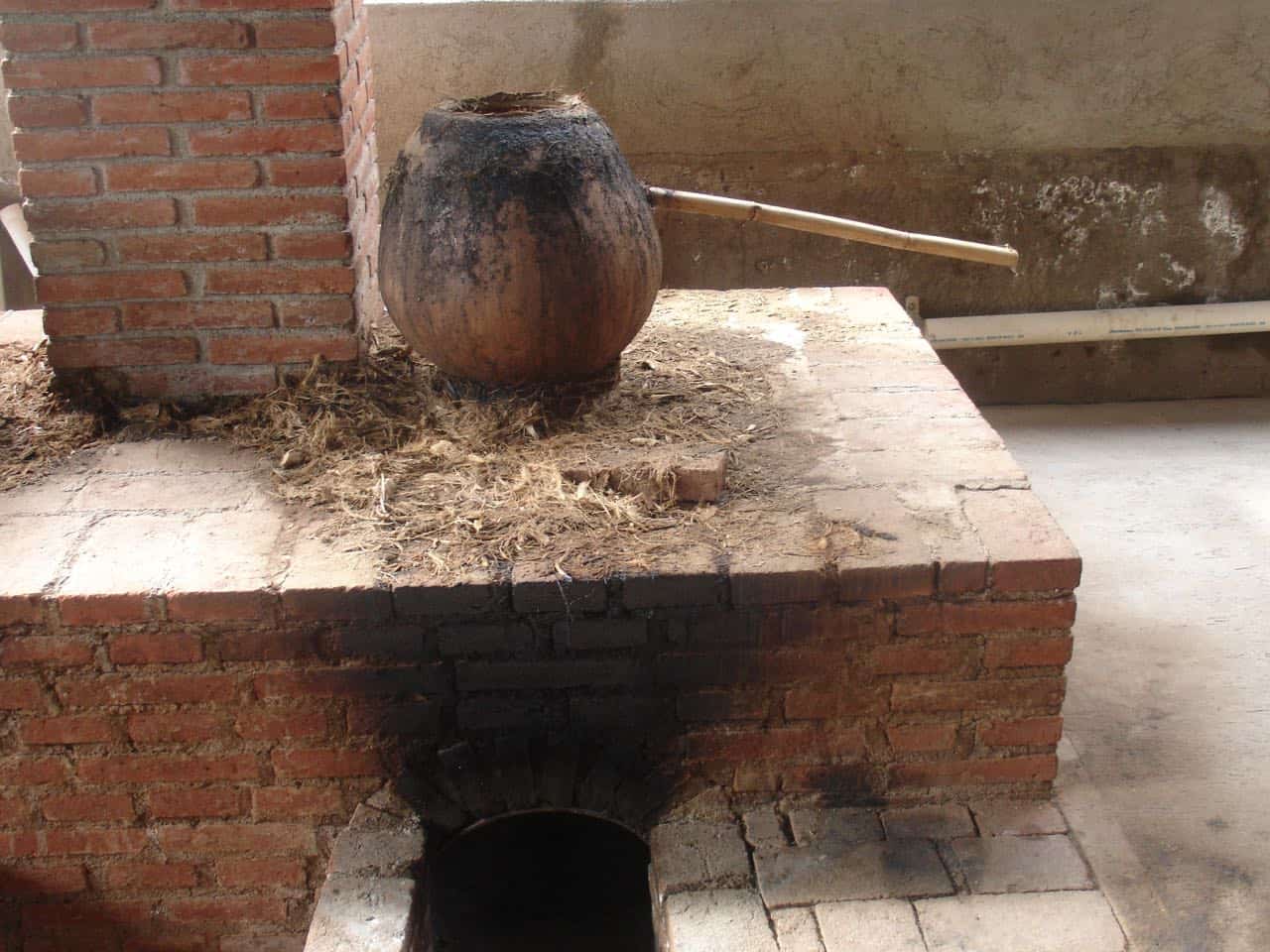
There’s also a fascinating picture of their distilling operation.  The still is something we haven’t seen before and would love to investigate further.  It’s described as of pre-Hispanic even though we’ve only ever heard that distilling arrived with the Spanish so that’s a point that bears some skepticism and further research.

Miguel Partida Rivera gives great insight into how some mezcal makers think about the relationship between of mezcal’s taste and alcohol level.  He claims that authentic mezcal has to be above 45-47%.  Below that it’s “water..with a taste of Maguey but with low quality,” which is a very traditional perspective in strong contrast with some new entries in the American marketplace like Wahaka which has consciously lowered the alcohol content in its entry level mezcal in order to make it more accessible to this market.

Mezcal in Michoacan

Mezcal can be made in many places, 7 Mexican states to be precise, so you would expect wide variation in tastes and how it’s made. Here’s a quick post from Alvin Starkman about how things are done in a particular palenque, or vinata as it’s called in Michoacan.


Update: A reader points out that Michoacan received it’s denominación de origen in February so there are now 8 states in Mexico authorized to make mezcal.  We apologize for that error.

A visit to Palenque Roaguia

We had a chance to visit palenquero Wilfreido Garcia Martinez at Palenque Roaguia on the road to Hierve el Agua.  Here’s a quick photo gallery of the visit that provides a little insight into his process, the world his mezcal comes from and the surrounding landscape.


Perfect Moments

I remember once hearing Spaulding Gray, the amazing monologist, talking about “the perfect moment.” It might have been from Swimming to Cambodia, or perhaps even during a live performance, I honestly can’t remember. But the idea of a perfect moment, when everything comes together to create a memory never to be forgotten, has stuck with me for years, and I hold those moments dear to my heart.

There’s that first time of climbing out of the clear, salty water at Emerald Isle in North Carolina. The dash up to the stairs to the walkway at the end of the deck; the turn of the handle and the sputter of warmish, brackish water jumping from the shower head, the sun setting, slight breeze, golden light. A moment clear as day. Another moment in Greece, on the isle of Lesvos, climbing the narrow and winding streets to the top of the hill, to the ruins. Again, a setting sun, but more than a breeze, enough to whip the waves of the steel blue Aegean Sea, to make the crest of the hill desolate, the Turkish shore across the straight seemed that much further. The smell of salt and baking lamb, me, catching my breath after the long climb up. I felt like I had conquered the world.

And then there is Oaxaca, where I have collected more than a few perfect moments over the years, each completely accidental. A hot car trip to San Dionisio – which I was disappointed to learn is named after Saint Dennis, and not in fact for Dionysius – not the usual impetus for perfect moments, but that is never the point: You can’t go in search of them. A hot morning, an ipod, my dear friend Ana and I talking men and music and mezcal, a visit to Don Pedro to retrieve a couple of bottles of mezcal (birthday presents for me and my mom) and then a meeting with Wahaka.

It’s hard to imagine how a friendship is forged between a 60 year-old palenquero from a small pueblo in Oaxaca and a foreign female from San Francisco, but it happened. I came bearing a gift of Old Potrero Rye from Anchor Distillery to show Don Pedro what’s happening in American distilling these days. He had framed the picture of the two of us taken during my last visit, and hung it on the wall of the Palenque filled with half naked calendar girls.

We talked mezcal, and pinches taxes (the common lament among small business owners everywhere) and then got around to sharing tales of our love lives, my current, his past. In truth, I relied heavily on Ana to translate, as Don Pedro’s Spanish is both gruff and mumbled. The heat was almost unbearable under the roof of the Palenque – the fire under the still at full strength, the noon sun above. A very drunk man stumbled in during our chat (three white plastic chairs in a circle on a dirt floor) his shirt completely open, a panza (belly) hanging over his belted pants. He appeared to have been driving, and seeing the difficulty he had just standing, well, those are the sad realities of drunk driving in Mexico.

Don Pedro had us try three mezcals he had made – a minero, a tobala and a pechuga. Here’s the reason why I love his mezcal – it is clean and forthright and simultaneously complicated. The first sip sets your mouth ablaze, and each after that becomes sweeter and mellower. It’s easy to understand how a bottle can disappear over a night’s meal or conversation. I listened to Ana get the third degree from Don Pedro – where are you from, are you married, have a boyfriend, want to have kids, who do you live with, will your parents get mad if I call you, and before long it was time to say goodbyes.

We drove to the center of San Dionisio, a cleaner more organized pueblo you could not imagine. We were meeting Francisco (Paco) Garcia of Wahaka Mezcal at the church before heading to the Palenque, which ended up being just a few blocks down from Don Pedro. I had met Paco the previous week at Los Amantes and was excited to visit the Palenque and hear the story, something so instrumental in understanding the flavor of a brand.

The Wahaka Palenque is surprisingly small given the output of 3500 liters a month. There is one pit oven, one mill, and three stills. It is a family operation, with Alberto (Beto) Morales, a fifth generation palenquero, overseeing everything. Wives, sisters, etc were labeling and packing boxes while we were there – a lot of it in preparation for the big April 30th party, celebrating the money raised in the US ($2,000) at a reception in Austin, Texas with Lila Downs for several schools in San Dionisio.

Beto talked about how he developed the Wahaka flavor profile – strong at front that finishes smooth and warm going down the throat. The challenge was to create a 40% (80 proof) mezcal that maintained the character and essence of a mezcal at a higher proof.  There is a world of difference between a 40% mezcal and a 45% mezcal when it comes to the complexity of flavor. Generally speaking, I prefer the stronger mezcals when I am drinking it straight. I think for cocktails, especially like the basil one I had at el Olivo one night, the Wahaka Ensemble is perfect.

Side note – Wahaka has an interesting outreach strategy in the US and are actively working with chefs (Rick Bayless and Jimmy Shaw to name a few.) I am biased, loving both food and mezcal, but I think this is a good way to get into the market.

We tried a bunch of different mezcals and I was surprised by how much I liked the reposado – aged for two years four months in barrel. I am not usually a reposado person.  I’m allergic to things aged in wood and have an overwhelming preference for the pure flavors of the blancos.  But this one was a well flavored, strong and had a lovely warm finish.  The madrecuixe, at 40%, had a long and spicy finish, the tobala at 47% had that wonderful full flavor explosion in the mouth and held its flavor for a while.  We also tried a 45% Ensemble that completely opened my nasal passages and was so utterly different from the 40% Ensemble that is was hard to believe they are the same mezcal mix (50% espadin, 25% tobala, 25% madrecuixe.)

After this little bit of lubrication, we walked down the road to see where much of the maguey is grown. It was a flat field on the flood plain of the river winding through. Plots of espadin were punctuated by those of corn and alfalfa. There were also random arroqueños (so much bigger than I could have imagined) and a few madrecuixe. It was a beautiful spot, though I cursed my shoe selection of sandals as my feet got coated by the loose dirt.

From there, Paco and Beto suggested we head to the office to talk a bit more. This meant climbing into the car provisioned with bottles of water, glasses and, of course, a bottle of mezcal. We drove further down the road toward Chichicapam and then turned up a dirt road, passing a school, and a field where Wahaka is cultivating madrecuixe. It is a project with the school so that the kids learn the planting process.  The madrecuixe are cultivated in an almost wild, haphazard, way while all the espadin are planted in neat rows.  This is all an experiment and time will tell if the project works, if the flavor changes, and if this test case is a blueprint for other wild maguey cultivation projects.

The road continued until we finally we arrived at the office, a gorgeous spot on the side of the hill, overlooking the valley below and the mountains on the other side. Trees line a natural cold spring pool, crystal clear with yellow and blue rocks sprinkled in and around the water. We walked over to a tree with a natural rock table and a circle of rocks around it – the office. The bottle of mezcal was put on the middle of the rock table and the conversation took a relaxed meandering path, from talking whiskey to the merits of large companies buying up the mezcal from small producers (money in these small guys pockets) to penetrating the US market to the importance or significance of the word artisanal, to nicknames for the various brands (an off the record conversation so it will not be repeated here) which had Ana and I in stitches. In fact we were in stitches most of the time as both Beto and Paco are extremely funny and have pretty much perfected the double entendre word play known as abur here in Mexico. And throughout the conversation, steers wondered in to drink from the spring pool, the sun moved lower, the air turned less warm (certainly cooler is not a word that can be used.) A perfect moment.

It’s good to have challenging conversations about the business of mezcal because huge issues hang in the balance; the pros and cons of large companies buying up mezcal throughout the valley from small producers for large batch production, cultivation of wild magueys, social responsibility of companies like Wahaka giving back to the community, capitalism in general, until it all came back to this truism from Paco – “a country without an alcohol is a country without an identity.”

I like these guys.

So like every other meeting with palenqueros, there was a test. The sun was settling lower, our bellies were rumbling, and we needed to think about heading home to Oaxaca. But first, the challenge: To cross the rocks in the water to get to the big rock, all while holding the bottle of mezcal. And thankfully I passed, though I would have happily fallen into that cool water.

We drove home with Paco, stopping once more in Tule to eat grilled meats and memelas at Elvira. The conversation became sillier, the jokes even more ribald (I didn’t understand half of them but could tell by the blush on Ana’s face that they were probably a little over the top.)  We promised to meet for drinks the following night, said quick goodbyes as we dropped Paco off, and then headed back to the house, blissfully tired and full.

Back to where it all began

The road to Teotitlan del Valle has changed a lot since I was first there in 2003. The pueblo sits off the main highway that heads south from Oaxaca toward the Istmo.  It’s only about 30 minutes from the city but my memory of the 2003 trip is that it took us much longer and it seemed like we were heading into the middle of nowhere.  Back then the road to the town was rutted and rough and, when we ended up going to taste the best mezcal our driver knew, the dirt road to the Del Maguey bodega seemed endless and long.

Not so today: Like so many excursions outside of Oaxaca there were wrong turns until finally we stopped and asked for directions from a very kind man in the centro of Teotitlan. Of course, you have to know that people will give you directions to a place even if they don’t know where it is – they just want to help. We finally arrived after more wrong turns and were greeted by the amazing team at Del Maguey, including Arturo and Francisco Martinez Martinez.

The operation has grown a lot since the last time I was there – the building that was once a small room now houses three rooms – an office, a storage area, and the bottling and waxing room (the tops of the Del Maguey bottles are dipped in a sealing wax, rather than the usual plastic wrap used by just about everyone else.) Given how successful Del Maguey has been in the US market, it is a surprisingly simple operation. And the road leading to the bodega, while still dirt and slightly rutted, is now dotted with buildings.

It is impossible to talk about artisanal mezcal in the US without mentioning Ron Cooper in the same sentence. His passion and perseverance in bringing his single village mezcals to the US has paved the way for everyone else, and certainly set the standard for quality. Del Maguey is one of the few brands in the market that is double organic certified, meaning that not only are the magueys that go into the process certified organic, but so is the mezcal making process itself. Given that the organic certification of the magueys often means certifying the entire community property of the pueblo where the maguey comes from, it is a huge task, and a huge point of pride for the brand. It also guarantees that the wild magueys known as silvestres growing in the zone are certified organic. For the actual mezcal making process, it means no air or chemicals or additives go into the process.

Del Maguey is distinct in many other ways, it’s part of the quirk  of the individuals that run these operations.  As another example, while some brands are re-planting silvestres, Del Maguey does not, and only harvests what grow wild on the pueblo properties, practicing responsible and sustainable techniques.  As Ron Cooper has said, “only God plants this.”

Francisco Martinez Martinez was full of information about Del Maguey’s process from field to bottle.  First, he reminded me that agave is a plant just like any other with seasons where the fruit is fully ripe and, since the process it truly artisanal, every step in mezcal production depends on a variety of factors.  During the rainy season (loosely June-August) it can be challenging. The colder weather impacts the mezcal making process – specifically related to attaining the desired alcohol level – the higher the grade, the harder it is to achieve it. The cold weather slows or stops natural airborne microbial fermentation. For Del Maguey and their mezcals, that means alcohol levels falling between 45-50%. Del Maguey and the Palenqueros they work with are  conscious about the flavors they strive for and lean toward a full bodied and bold flavor profile.  That’s not to say that they aren’t also wonderfully subtle in their flavors.

We also talked about some of the regional differences and challenges in growing maguey. The Valles Centrales (the pueblos surrounding Oaxaca on the valley floor) face challenges because of the cold mornings. While Del Maguey is headquartered in Teotitlan del Valle, the mezcal is not actually produced there, but instead comes from Santo Domingo Albarrados, San Juan del Rio, Chichicapam, and Santa Ana Taviche to name a few.  As Francisco said, “we make tapetes (truly beautiful hand crafted wool rugs) in Teo, not mezcal.”

But let’s get down to the nitty gritty of what we tasted…

We were very excited to taste one of their new products – their Santo Domingo Albarradas, aged for 60 days in barrels, enough to give it the flavor of a reposado, and a slight color change, but so very subtle. At 48%, it is quite the explosion of flavor in the mouth, and maintains its warmth as it slides down the back of the throat. I found it slightly less sweet than their non-aged Albarradas (which I think is a great dessert mezcal) and a little smoother.

As we were trying the mezcals, Don Francisco mentioned that several of the big mezcal companies are experimenting with making mezcal from the miel de agave – a less expensive and more industrial process, that gives the drink an essence of mezcal, but is very watered down. It also enables a factory to produce a lot more product – thousands of liters a month, vs the 2400 liters a year each of the palenques produce for Del Maguey. I also heard this from a few other people.  Chisme, “gossip,” about the industry is rampant here.

Next up were a few silvestres, including two new ones – a Papalome, which is similar to a Tobala, that I loved (talk about a flavor bomb in the mouth – wow! So complex, so strong and piquant, that finishes with a warm glow in the upper body), and a Tepestate, that was refreshing, smooth and sweet with a lovely almost watermelon flavor at the end. We also tried the Arroqueño (49%) that was so elegant and again smooth despite its alcohol punch, and the Tobala which was surprisingly light on the tongue and very herbal and green in its finish. Don Francisco had us try his personal favorite, the San Luis del Rio, and one I have had before. It’s a multi-layered mezcal, perfectly combining a sweet/sour flavor that stays with you for a while.

We finished with the granddaddy of them all – the Pechuga, produced only in the fall when the fruits used in the distillation are ripe in the mountains. I have come around to Pechugas in the past couple of years.  Initially I was resistant to embracing them fully because they are pretty cost prohibitive, both in Oaxaca and in other markets because of the time and complexity in their production process. But, when done well, as with the Del Maguey, have a deeply rich and complex flavor which has completely won me over.  That said I still drink relatively little Pechuga simply because it’s so expensive.

A side note about certifying the Pechuga mezcal organic: It took Del Maguey three years of work with the government and stacks of legal paperwork to get their Pechuga officially recognized and certified organic.  Not only that, a team of veterinarians were dispatched to the pueblo to draw blood from the chickens (pechuga can be made with either chicken or turkey) to ensure they were healthy and organic.

Once again, we found ourselves deliciously high on the mezcals we tried, and terribly hungry (how many times do I have to learn the lesson, eat first, then taste mezcal.) We stopped in Santa Maria Tule, home of the famous tule tree, and ate ourselves silly with grilled chorizo, onions, pork chops, lamb barbacoa, sopa de guias (the tender greens of the squash plant) memelas and quesadillas. It was quite simply, a perfect day.

An afternoon with Ulises Torrentera

Ulises Torrentera

Ulises Torrentera at his mezcaleria Txalaparta in Oaxaca.

I was excited to learn that a little mezcaleria had opened inside of one of my favorite bars in Oaxaca – Txalaparta. The mezcaleria is only open during the day from 1 to 7pm but it’s an extraordinary addition to the world of mezcal because it is run by Ulises Torrentera, the writer and author of several books and essays about mezcal. He is also somewhat of a personal mezcal hero for me – his writing captures not only his incredible knowledge of mezcal, but also his extraordinary literary voice. He tells the stories of mezcal that so perfectly reflect the life, culture and love that is so much a part of the mezcal story.

So I was nervous to say the least, and it was hot, and I had a bit of a headache from the night before (beer/mezcal – never a good combination) and my Spanish was feeling pretty rough.

How do you even begin to capture an afternoon of meandering conversation? You can have a list of questions on you but sometimes you just end up going on more of a journey, letting the discussion flow how it will. Ulises was behind the bar with his partner, Sandra.

Tasting menu at the mezcaleria

Ulises’s menu lists a variety of mezcals and currently features a new brand that Ulises and Sandra have developed called Farolito. It is all small batch, artisanal (will get to that in a bit), and composed of magueys I have never had before. We started with the Chato de Suchiltepec – a full bodied, 47% bottle, that blew my socks off. The flavor exploded up front on my tongue and then melted down my throat carrying such complexity.

Mezcal Farolito

And this led to the question of how you describe the flavor and experience of mezcal? I have always been challenged by this and, to be honest, I have struggled with the perception of snobbery in the vocabulary of wine and tequila.

As Ulises put it: When the flavors change across mezcals of a specific maguey – when you can’t define the flavor profile of a Tobalá, for example, because even within a maguey the flavor is dependent on where it is from (interestingly, there is no word for terroir in Spanish), what altitude it’s grown at, the hand of the palenquero who made the mezcal and other intangibles. There are hundreds and hundreds of mezcals in Oaxaca and not one is like the other – how can you build a vocabulary for this? Creating a vocabulary may not be a completely Quixotic adventure, it’s just that no one has really done it yet.

And so we talked about how tasting mezcal can conjure a specific memory like a wedding, or remind you of the sun setting over the mountain or of a mole you tasted in a pueblo. That’s why the current trend of industrializing the process, to make the flavor consistent, is just so damn sad and an anathema to what mezcal is.

Next up on the taste – Cuesh from San Juan del Rio which again exploded in my mouth. It opened my nasal passage and brought the front of my face alive. And then it finished so smooth and reminded me of a drive I took with my grandfather one fall afternoon on a winding road through the hollows of western Maryland, and how the sun dappled through the leaf laden oak and maple trees.

Then I asked him what artisanal mezcal was to him and he came up with the clearest explanation I have yet heard. Artisanal mezcal is made by one palenquero at one Palenque utilizing the process of roast, crush, ferment and distill that has been used for more than 400 years. Traditional mezcal is made the artisanal way, but involves more than one Palenque and palenquero for the final product. Semi-industrial utilizes some aspect of traditional production, but then has modernized or mechanized part of the process. Industrial is well, completely industrial and does not use any traditional methods. I hope these are the guiding definitions going forward. For my own purposes, I fully embrace these descriptions and this is what I now mean when I use the words.

Another question came up regarding NOM-186′s impact in Mexico. Anyone who supports small-scale production and producers sees it as the death knell for the truly artisanal approach to mezcal and Ulises is no exception. There is a great deal of opposition to it here in Oaxaca, and in Mexico overal.   The discussion will be long and there will be no resolution anytime soon. In the interim there has been an explosion of brands of mezcals. This is driving huge changes in the market. In the past, people bought barrels directly from palenqueros.  Restaurants and bars have mezcals of the house, which are also bought in barrels directly from palenques.  The growth of brands started in 2000 when the official denomination for mezcal was born.

And again, this led to the talk about the wild magueys (silvestres) and the over harvesting and the demand – something that has been increasing for several years. A lot of it started during the tequila crisis in the early 2000′s when there was a shortage of blue agave and producers in Jalisco began buying espadin and wild magueys to create a Tequilera, a blended tequila, to help keep production going. And now with more brands, more awareness, more demand for the silvestres, there is a tragic and growing danger of eradicating many of these magueys to meet the market demand.

Wild maguey can be cultivated, and some people are doing exactly that here in Oaxaca. Espadin is the most widely used maguey in mezcal because it is so easy to grow, and can pretty much grow anywhere. Wild magueys often have their own environmental  preferences that vary by elevation and other factors.  They also take 12 or more years to mature making the cultivation process a pretty expensive initial investment. So there is a bit of a gap right now until the cultivated silvestres really start producing, and thus the threat of over harvest remains. I am curious to see how much cultivation alters the flavors, and what kind of cross breeding we’ll be seeing in the future.

The thing is, it is not just wild magueys that are a pending ecological problem – there is also the issue of deforestation. The increasing demand for wood for firing the distillation process is also having an impact. As Ulises pointed out, currently there is no association, or formal organization overseeing a reforestation or replanting project in Oaxaca. Hence there is interest in the gas fired distillation process, but a lingering question about how that changes a fundamental flavor component of mezcal (that roasted/smokey depth.)

Which of course meant tasting another mezcal – a Jabalí (another Silvestre variety) from Sola de Vega – a town on the highway to Puerto Escondido. This one was so green and fresh and reminded me of that long and windy road over the mountains, of going from the drier Oaxacan Valley to the very verdant and cool mountains that separate this area from the sea.

It is possible to fall in love with a beverage, to have it be a calling. This project by Ulises is certainly that and is a labor of love – to bring the immensely varying flavors of each maguey to people and tell the stories of the makers, to ensure the experience and culture of mezcal is not lost in the rush to market.

So how to reconcile this changing market for mezcal with support for the palenqueros and pueblos? How to make sure the market does not end up dominated by big brands like Zignum (owned by Coca Cola) and that the knowledge and know how of 500 years is not lost in a push for efficiency and continuity of flavor? How to protect the diversity of the magueys and protect the ecology in the face of increasing demand? And how to make sure that money and recognition do not stray too far from the system of palenques that exists? These are certainly the questions that should dominate the discussion of mezcal in the years to come.

A girl walks into a mezcaleria…

Leon Langle, the bartender at Los Amantes in Oaxaca.

Leon Langle, the bartender at Los Amantes in Oaxaca.

It was a hot night and we’d just returned the rental car.  We planned on a little stroll, a little bite to eat – something relaxing. I stepped into Los Amantes while Alicia went to go grab a cup of coffee. I wanted to say hello to Leon Langle, the man behind the counter who knows his mezcal.

The space itself lends itself to easy conversation.  It’s a small, cozily lit shoebox of a space that’s  lined with antique glass jarras and benches.  Of course the entire space is defined by the bar with a rotating selection of mezcal depending on what’s available.   I never know what to expect:  One night it will be empty so Leon and I can conduct an extensive discussion on his wares.  The next evening it’s a colorful cacophony full of visitors from Mexico City and the odd celebrity sighting of Café Tacvba’s Ruben Albarran.  This night it seemed like an impromptu meeting of palenqueros and brand owners.

Los Amantes

Behind the bar at mezcaleria Los Amantes

There was Eric Hernandez, the palenquero behind Los Amantes and Ilegal, John Rexer, one of the owners of Ilegal, Francisco (mezcal and remembering last names can be a problem sometimes) from Wahaka Mezcal and Charles Collins from Real Matlatl. Eric had brought some pulque, a tart and refreshing drink that is less viscuous here in Oaxaca than the stuff I have tasted in Mexico City. I find it a nice accompaniment to mezcal – better than beer that can lead to a headache the following morning.

Leon poured me a madrecuixe/espadin mix, a pure madrecuixe and an arrenqueño.  NB: The “tastes” at Los Amantes are actually quite generous and are more like shots. Several conversations flowed including how much better my Spanish gets after a few mezcals, traditional dishes from Sinaloa (there was a chef from Sinaloa there,) what artisanal means and what is going on with the wild magueys.

The artisanal question is pretty big and there was no consensus on defining it. Is it when mezcal is made by one palenquero using the traditional process? Or is it based solely on the process so that brands can claim to be artisanal when they use mezcal from different palenques?  This is a question I ask all the time and it is fascinating that no one has the same answer. Unlike “organic” which is certified and therefore defined, artisanal is open to interpretation and, unfortunately, becoming highly misused (Round Table Pizza and their “artisanal” flat bread for example.)

As for the wild maguey question, it is a victim of its own demand at this point. Wild magueys often take 12 years to mature. Palenqueros like Enrique Jimenez (of Fidencio, Del Amigo and Mezcal Amores), Francisco of Wahaka, and many others control the land on which the wild magueys grow and are vested in harvesting only when they are ready. Other palenqueros who don’t have their own (either on their own land or communal property land – which is still very common in Oaxaca) or who don’t have agreements with communal property owners to harvest their own maguey, buy from harvesters who may be picking the magueys before they are ready. Given there is huge demand for the wild magueys, this is certainly an issue that needs to watched as there are huge ecological implications with the overharvesting that is happening. I love the wild maguey mezcals and the constant surprise of their flavor– one tobalá is different from another, the same with an arrenqueño, mexicano, tobaciche, etc. These are not every day mezcals.

Conversation then turned to music, which of course then lead to dancing. I wisely said my goodbyes and headed out to the brilliantly lit Santo Domingo before heading home.