Skip to content

Posts from the ‘Agave’ Category

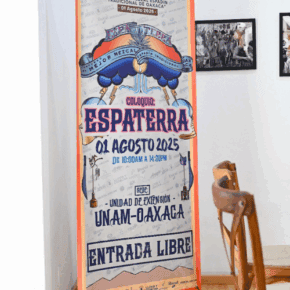
COMERCAM Meeting in Oaxaca

We got a heads up on a big COMERCAM meeting happening in Matatlan, Oaxaca this Saturday (full article here.) We are especially interested in this as some pretty contentious issues will likely be discussed including heavy crackdown on uncertified mezcal (small batch/small production mezcal) being sold into the market, domestic vs export market production, and regulatory controls. We’ll have a complete report next week about the meeting and what it might mean for the mezcal industry, or more specifically, small producers.

Journey to the Sierra Norte and Mezcal Tosba

One of the best things about going to palenques in Oaxaca is it usually means traveling to some of the most beautiful parts of the state. It also means traveling on some pretty rough roads, but more on that later.

I first met Elisandro Gonzalez-Molina in San Francisco at a mezcal tasting. He is one of the forces behind Mezcal Tosba, the other is his cousin Edgar Gonzalez-Ramirez. They are from the small pueblo of San Cristóbal Lachirioag in the Sierra Norte, a gorgeous and mountainous region northeast of the city of Oaxaca, and also one of the poorer regions in the state. Primarily Zapotec, with Mixtec pueblos mixed within, it is primarily alpine dotted by of tropical microclimates, not unlike what is found on the western side of the coastal mountains of Oaxaca.

Elisandro and Edgar came to the United States, like many of their pueblo neighbors, in order make a better life for themselves and also to send precious dollars back to San Cristóbal Lachirioag, a lasting legacy of NAFTA, that decimated these small agrarian pueblos in many parts of Oaxaca (and of course all over Mexico.) While in the US, they spent time talking about what they could do to bring economic opportunity to their pueblo, and staunch the flow of young people north. The idea of Mezcal Tosba was born; magueys were planted on Edgar’s family milpa beginning in 1999. In 2006 Edgar returned to Oaxaca to learn how to make mezcal.

The Sierra Norte is not a region currently known for mezcal production. Palenques had existed, but with so many people leaving the land for better opportunities, many of them were abandoned and the tradition began dying out. Far more common in the region was aguariente (a distilled beverage made from sugar cane), coffee and pulque.

Visiting Tosba soon became a obsession for me – not only for the opportunity to meet Edgar and see the Palenque, but also to have an excuse to travel to the Sierra Norte, where I had never been. Arranging it was another story – back and forth with Elisandro, coordinating with Edgar during one of his weekly trips to Oaxaca (there is no cell phone service in most of the Sierra Norte) and finally a meeting at In Situ to coordinate the details, including a map of how to get there.

There would be four of us on the journey – me, my partner in mezcal crime Ana JB and In Situ owners Ulises Torrentera and Sandra Ortiz Brena. We rented a more or less sturdy car (why car rental agencies in Oaxaca insist on using white cars is beyond me) and left the city at the crack of dawn on a Sunday morning.

I took the first leg of driving, mostly to ensure I’d be driving the “best” roads. Our plan was to hit the market in Ayutla, a Mixtec pueblo high in the mountains. We found a bustling commercial center where colectivo trucks unloaded people and their goods, and crisp in the clear, and quite cold, air. Luckily there was delicious coffee to be had and a filling breakfast of chilaquiles, enfrijolades and the best damn tortillas I have ever had (their rich corny flavor haunts my dreams to this day – think of the tortilla equivalent of the bread from Tartine.) We walked the market, taking in the sights and sounds of Mixteca and Zapoteca being spoken. We bought green coffee beans, flor del maguey, chilies and carne; the last to cook later that day at the Palenque. And then we found the pulque and tasted the seemingly infinite varieties and flavors to be found. Side note – I would travel for pulque and could become as obsessed with it as I am with mezcal.

We piled back in the car, though not before a couple of palenqueros called out to Ulises – we were after all traveling with a mezcal rock star – who were anxious to have him try their mezcals. It was not quite 9:30am.

I let Sandra take over the driving, a good thing because from Ayutla on it was dirt road – washed out, rutted, impassable during the rainy season, cliff hugging, you name it. The views were stunning and a constant reminder of just how high we were and just how far a drop it was off the edge of the road. I will never ever ever again complain about the pinche suburban trip to and from the coast in Oaxaca.

We met Edgar in the center of San Cristóbal, and from there, drove to the palenque – another 25 minutes on a rutted road, down the mountain. We parked our car at the top of the entry to the palenque because, while our car would have made it down, it never would have made it back up – it seems only Nissan Sentras can make that trip.

The palenque is nestled in one of the tropical microclimates. It is completely self-sustaining, growing everything needed for mezcal production – maguey, wood, fruits and vegetables – you name it, it grows. Currently there is one roasting pit, with plans for another. There is a large adobe building that will eventually house the bottling and labeling facility. Currently mezcal is transported to Oaxaca where it is bottled. There is a large tin roof covering the crushing area, the three fermentation barrels and three stills. There is no electricity, though Edgar is making plans for either solar or river generated power.

We ate papayas and lemons as Edgar showed us the lay of the land. He is utterly engaging and wickedly smart. In addition to the savings of the two cousins, they also secured a loan from FAO PESA, a UN funded program that provides capital for projects like these. Tosba makes three mezcals – an espadin, a tobala and a pechuga. Water for the mezcal comes from the river that flows down the mountain to the valley.

It was impossible to imagine how they could bottle mezcal here, or more to the point, it was impossible to imagine how the bottles would get to and from the palenque if my rattled bones were any indication. But the idea is that bottling there will provide more jobs for the pueblo.

It is stunningly beautiful at the palenque – it is surrounded by mountains and the play of light. So gorgeous and peaceful, we spent the afternoon talking mezcal and life. Edgar’s parents and sister arrived and we ate tlayudas and sopa de guias (a squash vine soup that is divine) and grilled meat and guacamole. And again I was struck by how delicious the tortillas were. I was even convinced to drink the water that came straight from the river (oh I put up a fight because it went against everything my traveler instinct told me.) It was delicious and I have to say, this is what makes the flavor of Mezcal Tosba so delicious – it really does taste like the water – fresh and slightly sweet.

After the meal, we set-off to hike to the waterfall and to see the maguey and the rest of the milpa. Edgar grabbed his rifle (jaguar country) and we set off. We walked the paths through the magueys that hugged the mountainside and eventually found ourselves walking under a canopy of trees as we neared the waterfall.  We stood in silence as we listened to the water moving over the rocks and looked upward as the fading light sprinkled through the leaves. We walked back through a grove of mango, looked over at the sugar cane, stared in wonder at the pineapple bushes and then finally returned to the palenque to watch the sunset across the valley. As it turned pitch black, we lit candles and stared at the stars as Edgar regaled us with tales of the jaguars, how he lost his eye while cutting maguey and hitting a stone (now all of his employees wear eye goggles) and other nights spent under the stars. We may also have engaged in ghost stories, but I will neither confirm nor deny that.

We finally decided it was time to head back to town – the trusty Sentra taking us back up to the car, which eventually took us back to town. We arrived in time for the posada celebration complete with Banda music and dancing and pan dulce. After, we went to Edgar’s parents, where we were spending the night. Somehow there was more food to be consumed, more mezcal to be had and more talking to be done. We tried the new espadin, which prompted an intense back and forth between Ulises and Edgar about why it tasted different than the last batch. Were the maguey from a different altitude – with the answer yes. It seemed impossible for me to believe that a 50-meter difference could change the flavor, but it did – though I only noticed after Ulises had said something. Oh to have his palette!

And then it was time for bed. It felt like the middle of the night but in fact it was only 10pm.

But sleep would elude us that night. We were awoken by the jarring sound of Banda music over the municipal loud speaker at about 4am. If you haven’t heard it before, think John Philip Sousa on crack. Oddly, it was followed by Strauss and kept going till about 6am when we finally gave up on getting any more sleep. Sadly, a local musician had passed away during the night, and this was his tribute.

We filled our mugs with coffee and headed up to the terrace to watch the sunrise. As the light came over the top of the mountain, the strains of Ave Maria wafted from the loudspeaker. We sat in silence as tears rolled down my cheek as I thought at that moment I was as close to my sister who had recently passed away as I could hope to be. It was majestic.

We then headed to Villa Alta for the Monday market, loaded up on baskets and chiles, dropped off Edgar and said our farewells, and then began the long trip back to Oaxaca.

Chilies at the Ayutla Market

Chilies at the Ayutla Market

Beans at the Ayutla market

Beans at the Ayutla market

fresh pulque, ayutla

fresh pulque, ayutla

pulque bottles

pulque bottles

Ayutla market

Ayutla market

The view in the Sierra Norte

The view in the Sierra Norte

Roasted maguey, Mezcal Tosba

Roasted maguey, Mezcal Tosba

Cutting maguey, Mezcal Tosba

Cutting maguey, Mezcal Tosba

Mezcal Tosba Palenque

Mezcal Tosba Palenque

Tlayudas

Tlayudas

Sopa de guias

Sopa de guias

Edgar Gonzalez-Ramirez

Edgar Gonzalez-Rodriguez

The water source, Mezcal Tosba

The water source, Mezcal Tosba

Tree canopy, Mezcal Tosba

Tree canopy, Mezcal Tosba

Sunset at Mezcal Tosba

Sunset at Mezcal Tosba

Dancing in the square in San Cristóbal Lachirioag

Dancing in the square in San Cristóbal Lachirioag

Sunrise in San Cristóbal Lachirioag

Sunrise in San Cristóbal Lachirioag

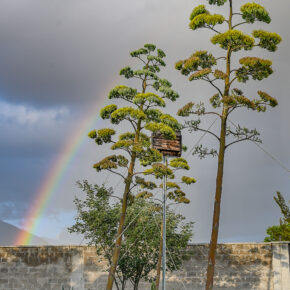
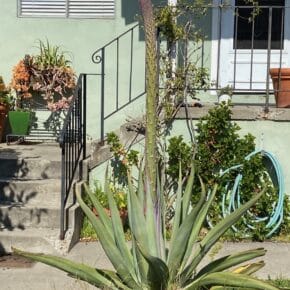
Urban agave

An agave in full bloom overlooking San Francisco.

An agave in full bloom overlooking San Francisco.

Agaves among us, down by the levee edition

Spotted at C and 20th Streets in Sacramento, CA. 


20th and C Streets, Sacramento, CA.

20th and C Streets, Sacramento, CA.

Agaves among us, size does matter

Spotted on Los Alamos Road in Sonoma.

Blooming agave on Los Alamos Road in Sonoma

Blooming agave on Los Alamos Road in Sonoma


Agave rumor alert

Rumors abound in Oaxaca that agave is being shipped north.  As with many rumors of this type, this one is hard to substantiate.  We’ve heard from several sources that this is happening.  We’re not sure where the agave is going though the assumption is clear.

We’ve heard from another source that agave is being shipped from South Africa to Mexico.  Again, this is unsubstantiated, but agave producers in South Africa have said that agave was shipped to Mexico in the past so this is something we’re digging into. We’re also hard at work sourcing some of that South African agave distillate to see how it compares with tequila and mezcal.  Given the recent addition of an Indian agave distillate perhaps we’ll see others on the market in the near future.  On a recent trip to southern Spain we were pleasantly surprised to see agave growing everywhere.  Andalusia has a climate climate and geography similar to Oaxaca and Jalisco so perhaps that will tempt entrepreneurial distillers there.

Saluting the blends

I dropped into Mezcaloteca the other night with some friends. It was an oddly quiet night since it was a Friday, the end of the month which is payday for everyone. It also happened to be the night before the big government change – Felipe Calderon to Enrique Peña Nieto (aka EPN). There was confusion over la ley seca (dry law) and if there was, in fact, one going into effect that night. As it turned out, it was only for Mexico City.

But back to Mezcaloteca and the 40 odd mezcals they have. They do a great job of providing information about each mezcal, clearly spelling out on the labels who the producer is, where it is from, alcohol percentage, what the maguey is, what it is distilled in (copper/clay/etc). In fact, with all that information, I had to pull out my reading glasses.

David in deep thought over mezcal

My friend David was working behind the bar that night and he made some great recommendations that included a raisilla from Guadalajara. It’s a wildly different flavor from mezcal, despite being maguey based and produced in a similar fashion to mezcal. Musky, that is how I would describe the one we tried.
But then there was the utterly delicious arroqueño and coyote blend that had an effervescence like nothing else I have ever tried, exploding on the front of the mouth and then slowly dissipating on the back of the tongue. The next blend was a 70% madrecuishe and 30% espadin that had such an intriguing soft sweetness, balancing out the usual green and minerali flavor of madrecuishe.

Rocking good espadin from Matatlan


Finally, we finished up with a 100% espadin from Matatlan – clocking in at 54.6% alcohol. Despite its high alcohol content, it did not have a strong flavor of that and was in fact surprisingly smooth.

I’ll have a follow-up piece about Mezcaloteca and their project in the coming days.

Bebidas of Mexico video

Finally had a chance to watch the Bebidas de Mexico show that broadcast on Sept. 8th in Mexico. It’s a snazzy piece that does a nice job of explaining the cultural impact of mezcal through interviews with writers, historians, and producers from the artisanal and industrial worlds.  It is in Spanish without subtitles but don’t worry if you don’t speak Spanish – the images tell the story of mezcal in loving detail.

As a bonus it is narrated by one of my favorite Spanish speaking actors, Daniel Jiménez Cacho.  You may recognize his voice because he also narrated the oh so awesome film Y tu mamá también. Give it a watch – I can guarantee you’ll be making a beeline to grab a copita as soon as possible.


Mezcal’s cousin pulque

Mexico Cooks has a great post about pulque, yet another fermented beverage made from agave but this one isn’t distilled. It’s drunk fresh and has a unique flavor and texture that can’t really be found outside of Mexico.  It’s arguably the predecessor of mezcal, pulque may have convinced someone that they could distill agave with that first still sent over from Spain.

Perfect Moments

I remember once hearing Spaulding Gray, the amazing monologist, talking about “the perfect moment.” It might have been from Swimming to Cambodia, or perhaps even during a live performance, I honestly can’t remember. But the idea of a perfect moment, when everything comes together to create a memory never to be forgotten, has stuck with me for years, and I hold those moments dear to my heart.

There’s that first time of climbing out of the clear, salty water at Emerald Isle in North Carolina. The dash up to the stairs to the walkway at the end of the deck; the turn of the handle and the sputter of warmish, brackish water jumping from the shower head, the sun setting, slight breeze, golden light. A moment clear as day. Another moment in Greece, on the isle of Lesvos, climbing the narrow and winding streets to the top of the hill, to the ruins. Again, a setting sun, but more than a breeze, enough to whip the waves of the steel blue Aegean Sea, to make the crest of the hill desolate, the Turkish shore across the straight seemed that much further. The smell of salt and baking lamb, me, catching my breath after the long climb up. I felt like I had conquered the world.

And then there is Oaxaca, where I have collected more than a few perfect moments over the years, each completely accidental. A hot car trip to San Dionisio – which I was disappointed to learn is named after Saint Dennis, and not in fact for Dionysius – not the usual impetus for perfect moments, but that is never the point: You can’t go in search of them. A hot morning, an ipod, my dear friend Ana and I talking men and music and mezcal, a visit to Don Pedro to retrieve a couple of bottles of mezcal (birthday presents for me and my mom) and then a meeting with Wahaka.

It’s hard to imagine how a friendship is forged between a 60 year-old palenquero from a small pueblo in Oaxaca and a foreign female from San Francisco, but it happened. I came bearing a gift of Old Potrero Rye from Anchor Distillery to show Don Pedro what’s happening in American distilling these days. He had framed the picture of the two of us taken during my last visit, and hung it on the wall of the Palenque filled with half naked calendar girls.

We talked mezcal, and pinches taxes (the common lament among small business owners everywhere) and then got around to sharing tales of our love lives, my current, his past. In truth, I relied heavily on Ana to translate, as Don Pedro’s Spanish is both gruff and mumbled. The heat was almost unbearable under the roof of the Palenque – the fire under the still at full strength, the noon sun above. A very drunk man stumbled in during our chat (three white plastic chairs in a circle on a dirt floor) his shirt completely open, a panza (belly) hanging over his belted pants. He appeared to have been driving, and seeing the difficulty he had just standing, well, those are the sad realities of drunk driving in Mexico.

Don Pedro had us try three mezcals he had made – a minero, a tobala and a pechuga. Here’s the reason why I love his mezcal – it is clean and forthright and simultaneously complicated. The first sip sets your mouth ablaze, and each after that becomes sweeter and mellower. It’s easy to understand how a bottle can disappear over a night’s meal or conversation. I listened to Ana get the third degree from Don Pedro – where are you from, are you married, have a boyfriend, want to have kids, who do you live with, will your parents get mad if I call you, and before long it was time to say goodbyes.

We drove to the center of San Dionisio, a cleaner more organized pueblo you could not imagine. We were meeting Francisco (Paco) Garcia of Wahaka Mezcal at the church before heading to the Palenque, which ended up being just a few blocks down from Don Pedro. I had met Paco the previous week at Los Amantes and was excited to visit the Palenque and hear the story, something so instrumental in understanding the flavor of a brand.

The Wahaka Palenque is surprisingly small given the output of 3500 liters a month. There is one pit oven, one mill, and three stills. It is a family operation, with Alberto (Beto) Morales, a fifth generation palenquero, overseeing everything. Wives, sisters, etc were labeling and packing boxes while we were there – a lot of it in preparation for the big April 30th party, celebrating the money raised in the US ($2,000) at a reception in Austin, Texas with Lila Downs for several schools in San Dionisio.

Beto talked about how he developed the Wahaka flavor profile – strong at front that finishes smooth and warm going down the throat. The challenge was to create a 40% (80 proof) mezcal that maintained the character and essence of a mezcal at a higher proof.  There is a world of difference between a 40% mezcal and a 45% mezcal when it comes to the complexity of flavor. Generally speaking, I prefer the stronger mezcals when I am drinking it straight. I think for cocktails, especially like the basil one I had at el Olivo one night, the Wahaka Ensemble is perfect.

Side note – Wahaka has an interesting outreach strategy in the US and are actively working with chefs (Rick Bayless and Jimmy Shaw to name a few.) I am biased, loving both food and mezcal, but I think this is a good way to get into the market.

We tried a bunch of different mezcals and I was surprised by how much I liked the reposado – aged for two years four months in barrel. I am not usually a reposado person.  I’m allergic to things aged in wood and have an overwhelming preference for the pure flavors of the blancos.  But this one was a well flavored, strong and had a lovely warm finish.  The madrecuixe, at 40%, had a long and spicy finish, the tobala at 47% had that wonderful full flavor explosion in the mouth and held its flavor for a while.  We also tried a 45% Ensemble that completely opened my nasal passages and was so utterly different from the 40% Ensemble that is was hard to believe they are the same mezcal mix (50% espadin, 25% tobala, 25% madrecuixe.)

After this little bit of lubrication, we walked down the road to see where much of the maguey is grown. It was a flat field on the flood plain of the river winding through. Plots of espadin were punctuated by those of corn and alfalfa. There were also random arroqueños (so much bigger than I could have imagined) and a few madrecuixe. It was a beautiful spot, though I cursed my shoe selection of sandals as my feet got coated by the loose dirt.

From there, Paco and Beto suggested we head to the office to talk a bit more. This meant climbing into the car provisioned with bottles of water, glasses and, of course, a bottle of mezcal. We drove further down the road toward Chichicapam and then turned up a dirt road, passing a school, and a field where Wahaka is cultivating madrecuixe. It is a project with the school so that the kids learn the planting process.  The madrecuixe are cultivated in an almost wild, haphazard, way while all the espadin are planted in neat rows.  This is all an experiment and time will tell if the project works, if the flavor changes, and if this test case is a blueprint for other wild maguey cultivation projects.

The road continued until we finally we arrived at the office, a gorgeous spot on the side of the hill, overlooking the valley below and the mountains on the other side. Trees line a natural cold spring pool, crystal clear with yellow and blue rocks sprinkled in and around the water. We walked over to a tree with a natural rock table and a circle of rocks around it – the office. The bottle of mezcal was put on the middle of the rock table and the conversation took a relaxed meandering path, from talking whiskey to the merits of large companies buying up the mezcal from small producers (money in these small guys pockets) to penetrating the US market to the importance or significance of the word artisanal, to nicknames for the various brands (an off the record conversation so it will not be repeated here) which had Ana and I in stitches. In fact we were in stitches most of the time as both Beto and Paco are extremely funny and have pretty much perfected the double entendre word play known as abur here in Mexico. And throughout the conversation, steers wondered in to drink from the spring pool, the sun moved lower, the air turned less warm (certainly cooler is not a word that can be used.) A perfect moment.

It’s good to have challenging conversations about the business of mezcal because huge issues hang in the balance; the pros and cons of large companies buying up mezcal throughout the valley from small producers for large batch production, cultivation of wild magueys, social responsibility of companies like Wahaka giving back to the community, capitalism in general, until it all came back to this truism from Paco – “a country without an alcohol is a country without an identity.”

I like these guys.

So like every other meeting with palenqueros, there was a test. The sun was settling lower, our bellies were rumbling, and we needed to think about heading home to Oaxaca. But first, the challenge: To cross the rocks in the water to get to the big rock, all while holding the bottle of mezcal. And thankfully I passed, though I would have happily fallen into that cool water.

We drove home with Paco, stopping once more in Tule to eat grilled meats and memelas at Elvira. The conversation became sillier, the jokes even more ribald (I didn’t understand half of them but could tell by the blush on Ana’s face that they were probably a little over the top.)  We promised to meet for drinks the following night, said quick goodbyes as we dropped Paco off, and then headed back to the house, blissfully tired and full.