Skip to content

New York after action report

I was in New York City last weekend for a wedding so I took the opportunity to sample the local mezcal scene. The big event was dinner at Empellon Cocina followed by drinks at Mayahuel but I also had lunch at Rosarito and chatted up bar tenders wherever we were. If you follow us on Twitter you already know my main observation: NY sees a different mezcal line up because of different distributors or distribution strategies. I noticed Buho in many bars as the sole member of the mezcal club, sadly but cutely stationed next to the Fortaleza and Partida, aka club agave. Del Maguey, Illegal and Fidencio were also frequent members but once we got to Empellon and Mayahuel things changed dramatically.

IMG_2939


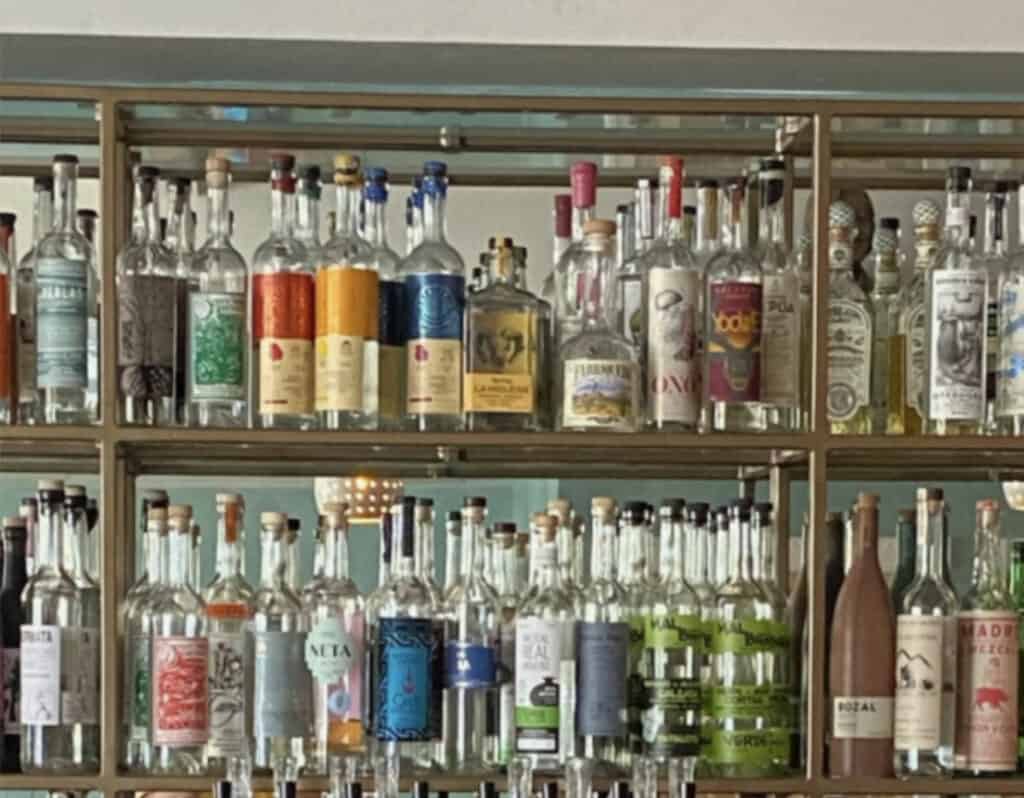
As you walk into Empellon you’re confronted with a cone of mezcals rising behind the bar capped with some fantastic rarities like a bottle of Real Minero. The menu is full of finds like that, there is a Mijes Joven, a Union, and a Yuu Baal. Then there are the full lines of the mezcals that we see in California like Del Maguey, Fidencio and Illegal.

Empellon is justly known for its food so be prepared for a special culinary experience, the squid with mole is a revelation but there are so many fun things that marry perfect technique with the world of Mexican ingredients that it’s hard to get bored. I thought the asparagus tacos would be the dud on the menu but it ended up being one of the best things there: Two fat stalks of asparagus in the middle of a tortilla topped by a mixture of parmesan and peppers and a bit of salsa off to the side. Simple and yet incredibly dynamic. Everything there paired perfectly with the long list of mezcals. 

Mayahuel is just around the corner and, while also a restaurant, it’s much more of a classic East Village scene. Their mezcal menu is a bit more limited but contains many of the same things at Empellon. As with most places that feature mezcal (including Empellon) the mezcal cocktails are the crowd pleasers. The space is bright, fun and loud spread out over two floords in something resembling an old Moroccan restaurant.

Later in the weekend we stopped for a quick lunch at Rosarito in Williamsburg and were pleasantly surprised to find that they had a robust mezcal menu. It seems like that’s the general trend but I’m looking forward to a more extensive research trip soon to make sure.

IMG_4060-1Obviously I missed plenty of places. I really wanted to visit Casa Mezcal which is a few short blocks from Empellon and Mayahuel but just couldn’t make it. Suffice to say that I’ll definitely visit on my next trip so if anyone has great ideas on where else to visit on that, as yet, unscheduled trip give us a buzz.

Mezcal tastings and movies in LA this May: Hola, La Guelaguetza and Mezcalistas

Two among many great events to recommend as part of the Hola Festival May 15-22. First, we’re co-hosting a great event at La Guelaguetza May 16. In conjunction with the ever-wonderful Bricia Lopez we’ll be presenting Pedro Jiménez’s Viva Mezcal, a documentary that looks at all the people and politics that go into making mezcal. It’s a fantastic tapestry and we’re really excited to be part of it. But, as they say in the business, there’s more! After the screening Chef Rodolfo Castellanos from Oaxaca will present a dinner complimented by a mezcal tasting. For tickets go here.  Here’s a taste of the documentary:


Viva Mezcal ® (Fragmento) / Viva Mezcal ® (Fragment) from pedro jimenez gurria on Vimeo.


Just a few days later on Sunday, May 19th La Gran Parrillada takes over La Plaza de Cultura Y Artes. Aficionados of new Mexican cooking take note because it’s a superstar line up with luminaries like Javier Plascencia heading the bill. There’s not a slacker in the group including Aquiles Chavez, Pablo Salas, Rodolfo Castellanos and Jose Ramon Castillo. This being a showcase for the Mexican culinary moment, there will also be tequila, mezcal and some interesting Mexican wines. For tickets go here.

COMERCAM Meeting in Oaxaca

We got a heads up on a big COMERCAM meeting happening in Matatlan, Oaxaca this Saturday (full article here.) We are especially interested in this as some pretty contentious issues will likely be discussed including heavy crackdown on uncertified mezcal (small batch/small production mezcal) being sold into the market, domestic vs export market production, and regulatory controls. We’ll have a complete report next week about the meeting and what it might mean for the mezcal industry, or more specifically, small producers.

Music+Art+Mezcal=Fun

A tremendous thanks to all of you who stopped by Sub-Mission Gallery this past Saturday for our Music.Art.Mezcal. extravaganza. It was a dream come true to organize an event like this. For me, I can’t imagine mezcal existing in a vacuum without music, art and food to accompany it. It’s personal for sure and goes back to that moment in time in 2003, in the panteon in Oaxaca, surrounded by Dia de los Muertos altars, banda musica, dancers and a bottle of mezcal being passed around.

Of course a huge thank you to the artists whose work adorned the walls: Calixto Robles, Joaquin Newman, Txutxo Perez, Lapiztola Stencil, Yescka, Lorena Zertuche, Viet Chévez and Knut Hildebrandt. All of the art is for sale, so if you see something in the below gallery that catches your fancy, let us know and we’ll connect you with the artist!

We were also blessed with delicious mole and empanadas from Soul Cocina and a mezcal mocha banana creme brulee from The Creme Brulee Man that was heaven on earth.

Max and I had a great time talking mezcal, sharing the stories (and tastes) of mezcal from Don Pedro Garcia, Reyna Sanchez (Reinita) and Mezcal Tosba.

Check out the great photos that hopefully capture the energy of the night. There is something potent and magical about the combination of food, art, music and mezcal. We are hoping this is the first of more – and in fact, plans are underway for another extravaganza at the end of July.

Again, thanks for such a fun night!

Art by Yescka

Art by Yescka

Photos by Knut Hildebrandt

Photos by Knut Hildebrandt

Los Magueyes by Lorena Zertuche

Los Magueyes by Lorena Zertuche

Photos by Viet Chévez

Photos by Viet Chévez

Lapiztola Stencil

Lapiztola Stencil

El tigger by Lapiztola Stencil

El tigger by Lapiztola Stencil

Art by Joaquin Newman

Art by Joaquin Newman


Max talking mezcal

Max talking mezcal

happy attendee

happy attendee

IMG_0313

Admiring the art

Admiring the art

Txutxo Perez

Txutxo Perez

IMG_0383 IMG_0387

Food by Soul Cocina

Food by Soul Cocina

IMG_0463 IMG_0489

Mezcal Tosba

Mezcal Tosba

IMG_0509 IMG_0510 IMG_0515 IMG_0526 IMG_0533 IMG_0539 IMG_0542

Lorena Zertuche and her wall of Los Magueyes

Lorena Zertuche and her wall of Los Magueyes

IMG_0559 IMG_0602

DJ Ricardo Ibarra of Radio Indigena spinning tunes

DJ Ricardo Ibarra of Radio Indigena spinning tunes

IMG_0613 IMG_0622 IMG_0692 IMG_0698

Yescka and friends

Yescka and friends

IMG_0747 IMG_0769 IMG_0774 IMG_0844 IMG_3763 IMG_3770

Art by Txutxo Perez

Art by Txutxo Perez

IMG_3785

Art by Txutxo Perez

Art by Txutxo Perez

Stencil by Lapiztola Stencil

Stencil by Lapiztola Stencil

Mezcal photo wall by Knut Hildebrandt

Mezcal photo wall by Knut Hildebrandt

T-shirts by Yescka

T-shirts by Yescka

Mezcales Don Pedro y Reinita

Mezcales Don Pedro y Reinita

Artist Calixto Robles and his daughter

Artist Calixto Robles and his daughter

Jaguar y Magueyes by Calixto Robles

Jaguar y Magueyes by Calixto Robles

Art by Joaquin Newman

Art by Joaquin Newman

The patio at Sub-Mission

The patio at Sub-Mission

The chefs

The chefs

IMG_3882 IMG_3900 IMG_3906 IMG_3919 IMG_3928 IMG_3949 IMG_3963 IMG_4006 IMG_4019

Mezcal, food, art and music this Saturday in San Francisco

We’re having another tasting, this time it includes a band, a clip from a documentary about mezcal, a little pop up dining action, art on the walls and a very special group of mezcals. Here’s the flyer, hope to see you there Saturday evening.


Basic CMYK

Alto al Saqueo!

So says a local Oaxacan newspaper on the topic of local agaves flowing north.

Mexican murals and mezcal in LA: Does it get any better than this?

If you’re in LA Wednesday, March 14th RSVP for a great event at Guelaguetza where Susan will show her photos, help with a tasting and La Piztola will unveil a mural.


FLIER-01

Journey to the Sierra Norte and Mezcal Tosba

One of the best things about going to palenques in Oaxaca is it usually means traveling to some of the most beautiful parts of the state. It also means traveling on some pretty rough roads, but more on that later.

I first met Elisandro Gonzalez-Molina in San Francisco at a mezcal tasting. He is one of the forces behind Mezcal Tosba, the other is his cousin Edgar Gonzalez-Ramirez. They are from the small pueblo of San Cristóbal Lachirioag in the Sierra Norte, a gorgeous and mountainous region northeast of the city of Oaxaca, and also one of the poorer regions in the state. Primarily Zapotec, with Mixtec pueblos mixed within, it is primarily alpine dotted by of tropical microclimates, not unlike what is found on the western side of the coastal mountains of Oaxaca.

Elisandro and Edgar came to the United States, like many of their pueblo neighbors, in order make a better life for themselves and also to send precious dollars back to San Cristóbal Lachirioag, a lasting legacy of NAFTA, that decimated these small agrarian pueblos in many parts of Oaxaca (and of course all over Mexico.) While in the US, they spent time talking about what they could do to bring economic opportunity to their pueblo, and staunch the flow of young people north. The idea of Mezcal Tosba was born; magueys were planted on Edgar’s family milpa beginning in 1999. In 2006 Edgar returned to Oaxaca to learn how to make mezcal.

The Sierra Norte is not a region currently known for mezcal production. Palenques had existed, but with so many people leaving the land for better opportunities, many of them were abandoned and the tradition began dying out. Far more common in the region was aguariente (a distilled beverage made from sugar cane), coffee and pulque.

Visiting Tosba soon became a obsession for me – not only for the opportunity to meet Edgar and see the Palenque, but also to have an excuse to travel to the Sierra Norte, where I had never been. Arranging it was another story – back and forth with Elisandro, coordinating with Edgar during one of his weekly trips to Oaxaca (there is no cell phone service in most of the Sierra Norte) and finally a meeting at In Situ to coordinate the details, including a map of how to get there.

There would be four of us on the journey – me, my partner in mezcal crime Ana JB and In Situ owners Ulises Torrentera and Sandra Ortiz Brena. We rented a more or less sturdy car (why car rental agencies in Oaxaca insist on using white cars is beyond me) and left the city at the crack of dawn on a Sunday morning.

I took the first leg of driving, mostly to ensure I’d be driving the “best” roads. Our plan was to hit the market in Ayutla, a Mixtec pueblo high in the mountains. We found a bustling commercial center where colectivo trucks unloaded people and their goods, and crisp in the clear, and quite cold, air. Luckily there was delicious coffee to be had and a filling breakfast of chilaquiles, enfrijolades and the best damn tortillas I have ever had (their rich corny flavor haunts my dreams to this day – think of the tortilla equivalent of the bread from Tartine.) We walked the market, taking in the sights and sounds of Mixteca and Zapoteca being spoken. We bought green coffee beans, flor del maguey, chilies and carne; the last to cook later that day at the Palenque. And then we found the pulque and tasted the seemingly infinite varieties and flavors to be found. Side note – I would travel for pulque and could become as obsessed with it as I am with mezcal.

We piled back in the car, though not before a couple of palenqueros called out to Ulises – we were after all traveling with a mezcal rock star – who were anxious to have him try their mezcals. It was not quite 9:30am.

I let Sandra take over the driving, a good thing because from Ayutla on it was dirt road – washed out, rutted, impassable during the rainy season, cliff hugging, you name it. The views were stunning and a constant reminder of just how high we were and just how far a drop it was off the edge of the road. I will never ever ever again complain about the pinche suburban trip to and from the coast in Oaxaca.

We met Edgar in the center of San Cristóbal, and from there, drove to the palenque – another 25 minutes on a rutted road, down the mountain. We parked our car at the top of the entry to the palenque because, while our car would have made it down, it never would have made it back up – it seems only Nissan Sentras can make that trip.

The palenque is nestled in one of the tropical microclimates. It is completely self-sustaining, growing everything needed for mezcal production – maguey, wood, fruits and vegetables – you name it, it grows. Currently there is one roasting pit, with plans for another. There is a large adobe building that will eventually house the bottling and labeling facility. Currently mezcal is transported to Oaxaca where it is bottled. There is a large tin roof covering the crushing area, the three fermentation barrels and three stills. There is no electricity, though Edgar is making plans for either solar or river generated power.

We ate papayas and lemons as Edgar showed us the lay of the land. He is utterly engaging and wickedly smart. In addition to the savings of the two cousins, they also secured a loan from FAO PESA, a UN funded program that provides capital for projects like these. Tosba makes three mezcals – an espadin, a tobala and a pechuga. Water for the mezcal comes from the river that flows down the mountain to the valley.

It was impossible to imagine how they could bottle mezcal here, or more to the point, it was impossible to imagine how the bottles would get to and from the palenque if my rattled bones were any indication. But the idea is that bottling there will provide more jobs for the pueblo.

It is stunningly beautiful at the palenque – it is surrounded by mountains and the play of light. So gorgeous and peaceful, we spent the afternoon talking mezcal and life. Edgar’s parents and sister arrived and we ate tlayudas and sopa de guias (a squash vine soup that is divine) and grilled meat and guacamole. And again I was struck by how delicious the tortillas were. I was even convinced to drink the water that came straight from the river (oh I put up a fight because it went against everything my traveler instinct told me.) It was delicious and I have to say, this is what makes the flavor of Mezcal Tosba so delicious – it really does taste like the water – fresh and slightly sweet.

After the meal, we set-off to hike to the waterfall and to see the maguey and the rest of the milpa. Edgar grabbed his rifle (jaguar country) and we set off. We walked the paths through the magueys that hugged the mountainside and eventually found ourselves walking under a canopy of trees as we neared the waterfall.  We stood in silence as we listened to the water moving over the rocks and looked upward as the fading light sprinkled through the leaves. We walked back through a grove of mango, looked over at the sugar cane, stared in wonder at the pineapple bushes and then finally returned to the palenque to watch the sunset across the valley. As it turned pitch black, we lit candles and stared at the stars as Edgar regaled us with tales of the jaguars, how he lost his eye while cutting maguey and hitting a stone (now all of his employees wear eye goggles) and other nights spent under the stars. We may also have engaged in ghost stories, but I will neither confirm nor deny that.

We finally decided it was time to head back to town – the trusty Sentra taking us back up to the car, which eventually took us back to town. We arrived in time for the posada celebration complete with Banda music and dancing and pan dulce. After, we went to Edgar’s parents, where we were spending the night. Somehow there was more food to be consumed, more mezcal to be had and more talking to be done. We tried the new espadin, which prompted an intense back and forth between Ulises and Edgar about why it tasted different than the last batch. Were the maguey from a different altitude – with the answer yes. It seemed impossible for me to believe that a 50-meter difference could change the flavor, but it did – though I only noticed after Ulises had said something. Oh to have his palette!

And then it was time for bed. It felt like the middle of the night but in fact it was only 10pm.

But sleep would elude us that night. We were awoken by the jarring sound of Banda music over the municipal loud speaker at about 4am. If you haven’t heard it before, think John Philip Sousa on crack. Oddly, it was followed by Strauss and kept going till about 6am when we finally gave up on getting any more sleep. Sadly, a local musician had passed away during the night, and this was his tribute.

We filled our mugs with coffee and headed up to the terrace to watch the sunrise. As the light came over the top of the mountain, the strains of Ave Maria wafted from the loudspeaker. We sat in silence as tears rolled down my cheek as I thought at that moment I was as close to my sister who had recently passed away as I could hope to be. It was majestic.

We then headed to Villa Alta for the Monday market, loaded up on baskets and chiles, dropped off Edgar and said our farewells, and then began the long trip back to Oaxaca.

Chilies at the Ayutla Market

Chilies at the Ayutla Market

Beans at the Ayutla market

Beans at the Ayutla market

fresh pulque, ayutla

fresh pulque, ayutla

pulque bottles

pulque bottles

Ayutla market

Ayutla market

The view in the Sierra Norte

The view in the Sierra Norte

Roasted maguey, Mezcal Tosba

Roasted maguey, Mezcal Tosba

Cutting maguey, Mezcal Tosba

Cutting maguey, Mezcal Tosba

Mezcal Tosba Palenque

Mezcal Tosba Palenque

Tlayudas

Tlayudas

Sopa de guias

Sopa de guias

Edgar Gonzalez-Ramirez

Edgar Gonzalez-Rodriguez

The water source, Mezcal Tosba

The water source, Mezcal Tosba

Tree canopy, Mezcal Tosba

Tree canopy, Mezcal Tosba

Sunset at Mezcal Tosba

Sunset at Mezcal Tosba

Dancing in the square in San Cristóbal Lachirioag

Dancing in the square in San Cristóbal Lachirioag

Sunrise in San Cristóbal Lachirioag

Sunrise in San Cristóbal Lachirioag

Amigos del Maguey – Festival DARDO

An interesting website/event popped up recently – Amigos del Maguey. It’s in Spanish, and gives a nice run down of the various distilled agave beverages (mexcal, sotol, bacanora, raicilla, tequila, etc.) But what caught our eye is the comprehensive destilados del origen artisenales (DARDO) exposition happening in Mexico City on March 16th.

In addition to opportunities to taste the different distilled products, there will also be food, talks and a cocktail contest.

If you are looking for an excuse to travel to Mexico City, this just might be it!

Sacramento and silvestres

Mezcaleria at Mayahuel Sacramento

The mural behind the bar at Mayahuel.

I spent a recent weekend in Sacramento visiting friends and sampling the local mezcal scene. We couldn’t find a ton of action but there are promising developments on the horizon. There are some excellent places to drink tequila and where there’s tequila, mezcal isn’t far behind.

The taco bar at Mayahuel is a happening spot. It’s billed as a tequila museum and they definitely offer the full tequila experience but they also feature a rear bar devoted to mezcal and a variety of great snacks like blue corn tacos with rajas and a few others that aren’t standard fare. While they don’t offer an incredibly wide variety of mezcals they appear to be doing a bang up business in mezcal based cocktails; the night we were there a young crowd was sucking them down like no tomorrow. The main bar is completely devoted to tequila, it’s quite a pyramid of bottles, and you’ll feel the blue agave asserting its power throughout the restaurant including a really nice set of maps of the Jalisco NOMs in the bathroom. Seldom have I seen drinks better advertised in such a strange location. There’s also a huge event room fronted by tequila lockers, apparently it’s used frequently for politically events so that should give you an idea of the general scene.

The Mezcaleria at Mayahuel

Mayahuel’s mezcaleria.

But back to the mezcal bar in the rear of the restaurant. It has its own murals based on Mexican street art and it is run by a bartender named Oscar. He’s very enthusiastic about mezcal and happy to set you up with a selection. While his list isn’t tremendously deep he does stock the Fidencio line, a pair of Del Magueys, Sacaceunto and a few others. Sadly he didn’t have any silvestres. It’s one of those situations where the variety that is present, the crowd and enthusiasm behind the bar creates its own little scene. We sampled the Sacacuento anejo, the Fidencio pechuga and the Delirio joven

Mezcals at Mayahuel

Mezcals at Mayahuel

As noted above the stock in trade appears to be cocktails and that’s part of the larger mezcal trend in the U.S.. I bet the vast majority of mezcal consumed domestically is in cocktails so we’ll probably see more brands targeted at that space. Mezcal cocktails are popping up all over the place and seem like they’re the gateway for future mezcal lovers. Bartenders love using mezcal because it’s novel and offers a different flavor platform. Like tequila I bet most people never get beyond the margerita but that’s par for the course. Not everyone likes or gets to Fortalezza and that’s just the way things work.

They have a nice mural of all the NOMs in Jalisco spread across the male bathroom. We need a female informant to tell us about that bathroom.

Mayahuel’s mural of all the NOMs in Jalisco in the male bathroom. We need a female informant to tell us about that bathroom.

Later in the evening we popped over to Zocolo, another big tequila emporium set in an old car dealership with great floral arrangements. As far as I could tell, and my bartender knew, they only serve tequila so we had to content ourselves with that and a discussion of how Mexican food and tequila are the new sushi and sake.

One of the highlights of the trip and one of the major reasons for being there was to conduct a tasting for a local macher who described himself as someone taken with mezcal but not exposed to much of it. I brought up a diverse line up:

  • The La Niña Espadin
  • Wahaka’s Reposado con Gusano
  • Alipus San Andres
  • Del Maguey Minero
  • Pierde Almas Dobadaan
  • Cuish Cirial
  • Cuish Tobaziche
  • Cuish Papalometl

As we worked through the espadins our taster said, “yeah, these are more the ones that taste like gasoline, I have a few of these at home.” I can understand where he’s coming from because many high alcohol Espadins really overwhelm you with their alcoholic power. Plus, you have to be sensitized to the taste beyond the alcohol. This guy obviously saw something there and that became readily apparent as soon as we cracked the Cuish silvestres. It wasn’t love at first sight but he was obviously struck by them and gave us the  ’this is what I’ve been looking for!’.

It’s fantastic to see that happen. I know he’ll be back for more. But it’s also deeply troubling because silvestres are an issue of deep complexity. They express the incredible nuance and variety of mezcal because they literally bring the diversity of the fruit at the root of this distillate to light. It’s where mezcal makes the wine metaphor sing the loudest and most astute. And, they’re the things that really grab neophytes.

The problem and complexity arise from their very being; since they’re wild they’re very rare. There’s a huge divergence between growing marketplace demand and what Mexico, let alone the defined denomination within Mexico, can supply. That demand creates pressure to harvest early and cut other corners which causes environmental issues and can harm the greater brand. So, prices are already high and will inevitably grow higher which is a good thing because the market really can take care of this side of things. If silvestres get marketed as exclusive that will help create a positive image for mezcal that might just leave that stereotype of gusano swill to memory. The down sides are that more consumers are priced out of this market and, I’m almost certain, that the workers and palenqueros aren’t seeing their share of the income.

We’ll continue writing on this and related topics and, as winter wanes here in sunny California, we are planning a new series of tastings and mezcal related events so stay tuned for a spring full of action. You can always find out the latest on this blog, our Twitter feed and Facebook so stay tuned and, should you have an idea for a tasting, just send it our way.